
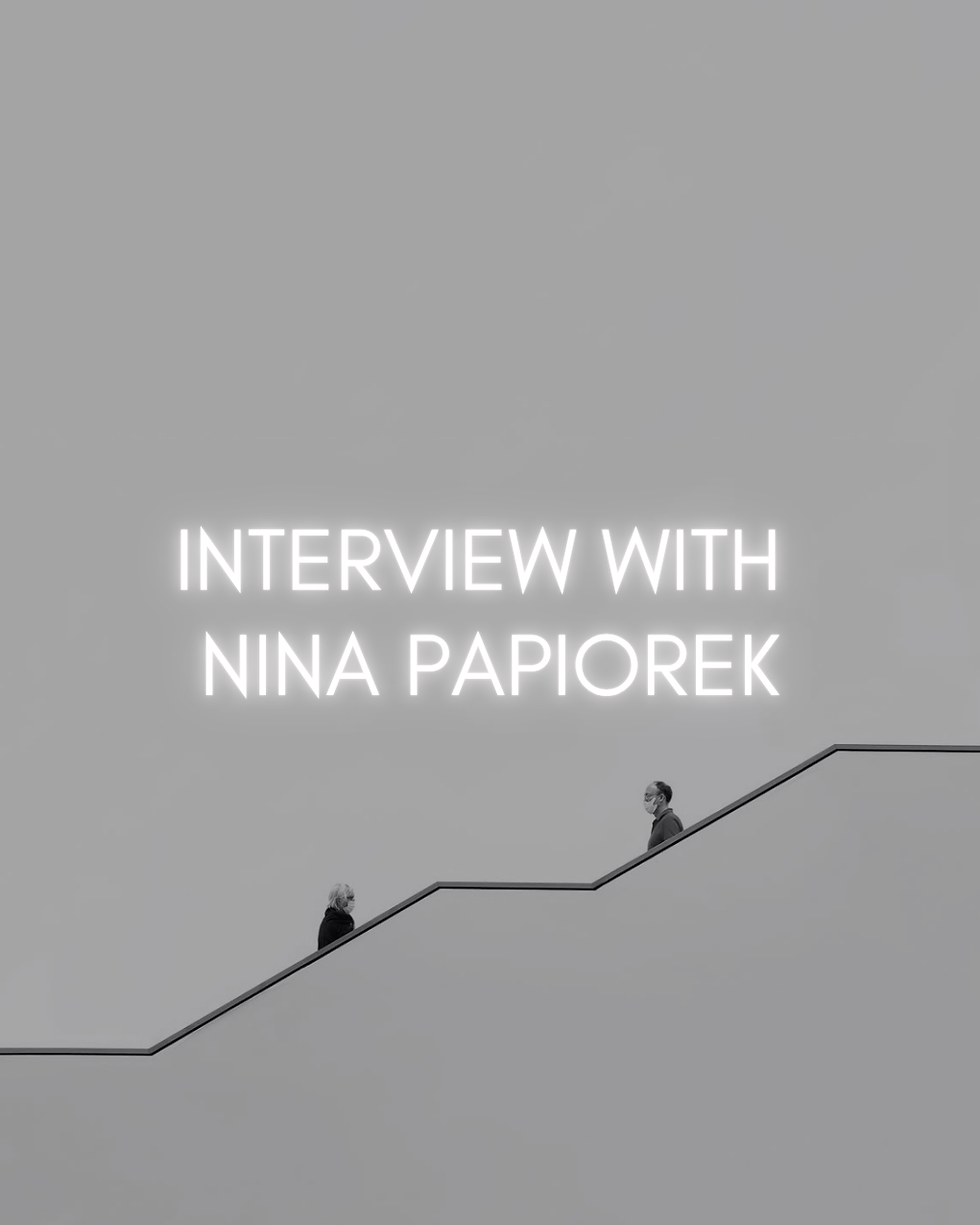
Interview with Nina Papiorek

Can you tell us a bit about yourself?
My name is Nina Papiorek and I am a professional street photographer based in Germany. I follow my passion for more than 20 years, with a focus on black and white, minimalism and street. My website: ninapapiorek.art
How did you first get into photography?
This story is very boring. I didn't have a family member who handed me a camera when I was a child. I discovered my passion entirely on my own; it wasn't until after I finished my studies that I bought my first camera to document my early travels.

What are your favourite shooting conditions?
Whatever the day brings.
I really love fog because it always creates a mystical atmosphere that feels wonderfully quiet. At the same time, the fog swallows distracting elements in the background, automatically making scenes look more minimalist.
I like the sun for its sharp contrasts. However, I’ve probably taken some of my personal favorite photos while completely soaked in heavy rain. You have no control over the weather anyway and just have to take it as it comes—so why worry about it?
I see you shoot a lot of minimalistic street photography, can you tell us a bit about that?
Minimalism, for me, is not about photographing empty spaces. It is about removing everything that distracts from the story.
Cities are incredibly chaotic environments. There are signs, advertisements, traffic, crowds, and visual noise everywhere. My challenge is to organize that chaos into something calm and balanced. Sometimes this means waiting for a single person to enter a carefully composed architectural scene. Sometimes it means changing my perspective until unnecessary elements disappear completely.
The human figure plays a crucial role in my images. People provide scale, emotion, and often a narrative. Even when they appear very small within the frame, they become the element that transforms an architectural study into a photograph with a story.

What does photography mean to you?
Photography has become my way of understanding the world.
It encourages me to slow down, to observe carefully, and to notice beauty in places that many people walk past without a second glance. Every photograph is the result of patience, curiosity, and countless small decisions.
More importantly, photography has opened doors I never imagined. It has allowed me to travel the world, meet incredible people, and connect with a global community of photographers. But beyond all the exhibitions, books, and awards, photography remains something deeply personal. It constantly challenges me to grow—not only as an artist but also as a person.
What gear do you use?
I work exclusively with the FUJIFILM GFX system, that’s a medium format system. To most people, the idea of practicing street or travel photography with such large, heavy gear might sound completely absurd. For me, however, there are various reasons—ranging from the brilliance of the sensor to the intended use, such as large-format prints. Ultimately, though, choosing equipment today is always a decision driven by passion rather than technical considerations.

Can you walk us through your editing process?
My editing process varies for every single photo, as each one is shot under different conditions. I actually shoot in color, always using the RAW format as my starting point. All subsequent steps are tailored to the specific image. I still work manually in Photoshop—simply because I started twenty years ago, back before tools like Lightroom even existed. And, well, "never change a running system" ;) My main edits focus on black-and-white tonal values, contrast, and—if necessary—lighting adjustments. Depending on the quality of the source material, a photo might be finished in just a few minutes, or it could take up to an hour.
How do you decide on what moments to capture and which ones not?
I have a very "simple" attitude towards this. I think it’s fundamentally important and right to just go ahead and take every photo! If you miss a moment, it’s gone forever. If you end up photographing something boring, you can always delete it later if need be. I take far too many bad photos myself ;) but that’s all part of it; you simply can’t expect every shot to be a winner. In my eyes, practicing—and just getting out there and doing it—are the prerequisites for good photography.

What are some of your favourite photography techniques and why?
I don’t have a preferred technique. On the street, you generally have to act quickly; I like to use shutter priority when the situation calls for it—for instance, to avoid motion blur on people. However, I also quite like using undervoltage intentionally—such as in harsh sunlight—to anonymize subjects or bring out strong contrasts.
How did you find your unique photography style?
As a beginner, you’re always looking for your photographic "style." But I don't actually think that gets you anywhere. I never chased after anything like that; ultimately, you just do what you personally like—what you find aesthetically or otherwise appealing. And from that—and from growing experience—your personal style eventually emerges, ideally.

Do you see yourself as a street photographer, minimalism photographer, bnw photographer…? And why?
All my shots are candid; I don’t know my subjects, and I don’t ask anyone if they mind walking through my frame or anything like that. Since I shoot on the street, I would describe myself as a street photographer. But in any genre, you inevitably look beyond the boundaries—a solitary tree in the snow can sometimes be just as appealing to me. I don’t believe in letting myself be hemmed in by conventions or clichés.
Do you strictly shoot black and white, and if yes, why is that?
As I’ve mentioned before, I shoot in RAW—and therefore in color—but I am usually drawn to black-and-white photography. Colors often feel uncontrollable and distracting to me when there are too many of them in an image. However, I actually really like color photos when the palette is minimalist—for instance, when there are only one or two colors present. Personally, I probably find it far more difficult to create a good color image than a black-and-white one.
What’s the most challenging thing about photography for you?
It is about staying creative and not getting lost in the daily grind. As a photographer, you constantly need fresh ideas and must be able to summon a great deal of passion and vision. Personally, I find this comes naturally, as I am always striving for something new and for change. Yet everyone questions their photography and their approach from time to time—and that is the moment when you must be careful not to lose your way.
Can you walk us through a typical shooting day?
I get up before sunrise and head to a place where I can encounter typical city life—where locals are out and about and I can observe the everyday rhythm of the place. The early morning hours are my prime working time; tourists are still in bed, revealing the city’s authentic side. I spend the rest of the day as I please, observing the interplay of light and shadow and looking for interesting locations, backdrops, and stories. You can’t plan everything in street photography—and that’s a good thing!
What is your favourite subject to shoot, like in general?
Quiet city streets in the morning mist.
Do you listen to music during any part of your creative process and if yes how do you think it influences you?
I actually don’t listen to music while taking photos because it distracts me. For me, part of the experience is taking in the sounds of the city and the surroundings—it’s all one. I’m a huge music lover, and I tend to get too immersed in the music to stay focused. It’s a different story when I’m editing; then I enjoy listening to music or even watching series in the background.

Who are some photographers or other artists that inspire you?
My favorite photographer and a major source of inspiration is Fan Ho. His black-and-white images from the 1950s and 1960s capture everyday life, alleyways, markets, and the transformation of Hong Kong. It is incredible what Fan Ho created during that era, and I think his influence can also be seen in my own visual style.
How do you know when you’ve nailed the shot? Is it instinct or something else?
Often, I don't know—or I'm mistaken. You might have a good feeling about a photo, but frequently, it’s only in hindsight that you realize whether it’s truly good. In my opinion, it always helps to let a good amount of time pass between taking the shot and editing or publishing it. We often view our own images too emotionally because the scene and the people are still fresh in our minds; as a result, we often see things that outsiders simply cannot perceive.

How important is composition and lighting in photography?
Photography is all about light—after all, the very word implies nothing else. Of course, there is good light and bad light, yet one can still get the best out of an image even in poor lighting conditions. At the same time, no photo turns out well without successful composition; these two elements are therefore the decisive and essential factors. Developing a feel for image structure and composition should become second nature over the years, to the point where you no longer even have to think about it.
What’s your advice for someone who wants to start photography?
Want to read more?
Subscribe to themagazineforphotographers.com to keep reading this exclusive post.


