
Sony RX10 V Review: Is Sony’s New Bridge Camera Worth It?


After almost nine years, Sony has finally brought back the RX10 series with the new Sony RX10 V. The RX10 IV had become one of those cameras that developed a huge following over the years. Travelers loved it, wildlife photographers swore by it, and plenty of people appreciated having a single camera that could go from a wide 24mm landscape shot all the way to a 600mm telephoto without ever changing lenses.
The RX10 V keeps what made the previous model so popular. It still uses the excellent 24-600mm equivalent f/2.4-4 ZEISS Vario-Sonnar T* lens together with Sony’s familiar 20.1MP 1-inch stacked Exmor RS sensor. The big difference is everything around it. Sony has essentially modernized the entire camera by bringing over technology from its latest Alpha mirrorless lineup.
I’ve spent quite a bit of time going through hands-on reports, reviews, and sample galleries from dozens of photographers and reviewers to see whether this camera actually lives up to the hype + I also had some own hands on experiences myself. Here’s everything you need to know before buying it.
Who Is the Sony RX10 V For?
The RX10 V is still a premium bridge camera. That means you get a permanently attached lens instead of interchangeable lenses, but in return you get an incredibly versatile zoom range.
The 24-600mm equivalent lens covers almost every situation you could realistically encounter. Landscapes, architecture, portraits, sports, wildlife, birds, aviation…it’s all possible without carrying multiple lenses.
Unlike cheaper bridge cameras that rely on tiny sensors, Sony uses a much larger 1-inch sensor, which gives noticeably better image quality, dynamic range, and low-light performance.
Sony is clearly targeting people who want one camera that can do almost everything.
It’s especially suited for:
Wildlife photography
Bird photography
Travel
Sports
Aviation
Nature photography
General outdoor shooting
Hybrid photo and video creators
The biggest downside is the price. At $2,299, it certainly isn’t cheap for a fixed-lens camera. However, considering inflation and everything Sony has added over the RX10 IV, the pricing isn’t quite as outrageous as it first appears.

Design & Build Quality
The RX10 V feels much more like one of Sony’s modern Alpha cameras than the older RX10 IV.
The body is slightly larger and heavier, measuring 136.4 × 94.5 × 151.3 mm and weighing 1,111g including the battery and memory card. It’s definitely not pocket-sized, but that’s expected considering the huge zoom lens.
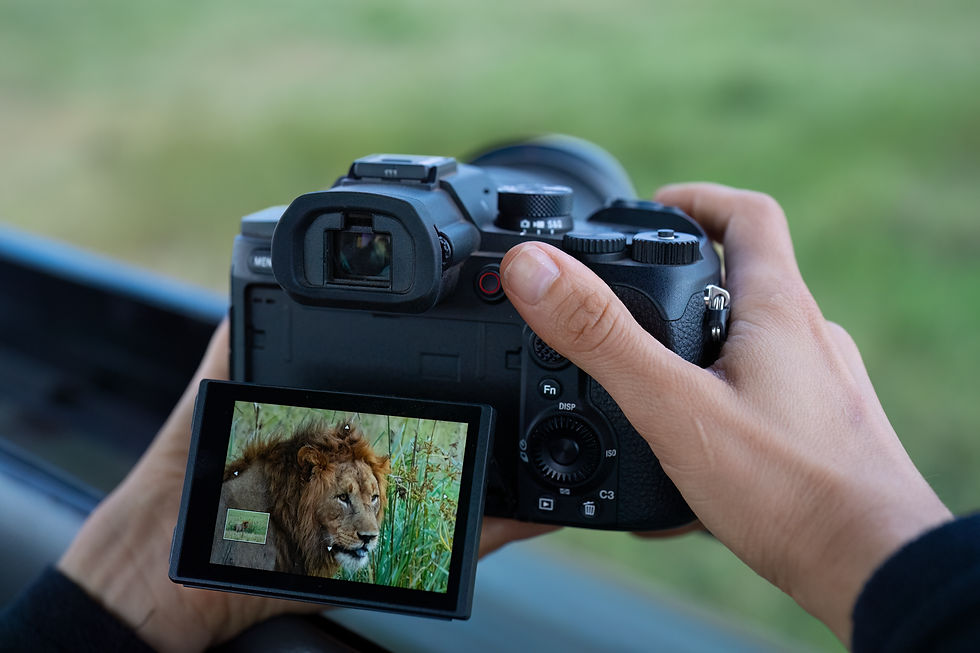
The new grip is noticeably deeper, making the camera much more comfortable to hold, especially when you’re shooting at 600mm for longer periods.
One of the biggest improvements is finally getting dust and moisture resistance, something RX10 users had been asking Sony for ever since the RX10 IV.
Sony has also completely redesigned the controls.
You now get:
AF joystick
Dedicated AF-On button
Better customizable controls
Improved command dials
Cleaner Alpha-style button layout
Sony also removed the built-in flash and the small top LCD display. Personally, I don’t think most people will miss either of them, especially considering the cleaner layout.
Around the side you’ll find:
USB-C
Micro HDMI
Microphone input
Headphone jack
The lens still has a 72mm filter thread, so adding ND filters or polarizers is straightforward.
Viewfinder & Screen
The electronic viewfinder receives a very welcome upgrade.
Instead of the older EVF, you now get a 3.68-million-dot OLED finder with 0.78x magnification, making it much sharper and easier to use.
The rear display is a 3-inch 1.62-million-dot touchscreen.
The only disappointment here is that it still only tilts up and down. I really wish Sony had gone with a fully articulating screen, especially considering how video-focused this camera has become.
Specifications
20.1MP 1-inch stacked Exmor RS CMOS sensor
ZEISS Vario-Sonnar T* 24-600mm equivalent f/2.4-4 lens
25x optical zoom
Optical Image Stabilization
BIONZ XR processor
Dedicated AI processing unit
575 phase detection AF points
Real-time Recognition Autofocus
Up to 30 fps electronic shooting
10 fps mechanical shooting
ISO 100-12,800
3.68M-dot OLED EVF
3-inch tilting touchscreen
4K 60p full-width 10-bit recording
4K 120p (cropped)
Full HD up to 240 fps
Single UHS-II SD card slot
NP-FZ100 battery
USB-C
Wi-Fi
Bluetooth
Dust and moisture resistance
Image Quality
The image quality will feel very familiar if you’ve used the RX10 IV.
That’s because Sony is using essentially the same 20.1MP stacked 1-inch sensor. Thankfully, that isn’t necessarily a bad thing because it was already an excellent sensor.
Photos remain detailed, sharp, and produce pleasant colors with good dynamic range for this sensor size.
Where I did notice an improvement is in the JPEG processing.
Thanks to the newer BIONZ XR processor:
Colors look slightly more refined
Skin tones appear more natural
Noise reduction is less aggressive
JPEGs generally look cleaner straight out of camera
The biggest limitation is still the sensor size.
Up to around ISO 800, image quality stays excellent.
ISO 1600 is still perfectly usable.
Beyond that, you start seeing noticeably more noise and softer detail as the camera’s noise reduction kicks in.
RAW shooters obviously have a bit more flexibility, especially if you’re using modern AI denoise software, but don’t expect APS-C or full-frame performance in difficult lighting.
Lens Performance
The biggest reason people buy an RX10 remains the lens.
The 24-600mm equivalent ZEISS lens is still incredibly impressive considering the enormous zoom range.
Sharpness is excellent through most of the range.
The sweet spot is definitely between 24mm and around 300mm, where the lens delivers consistently sharp results.
At the full 600mm end, things soften a little, which is completely expected, and atmospheric haze becomes more noticeable over long distances.
Even so, the lens performs remarkably well considering what it’s capable of.
Macro performance is another pleasant surprise.
You can focus extremely close, making it useful for flowers, insects, textures, and product photography without needing a dedicated macro lens.

Autofocus Performance
This is easily one of the biggest upgrades over the RX10 IV.
Sony has brought over its latest Real-time Recognition Autofocus, powered by both the BIONZ XR processor and a dedicated AI chip.
You now get subject recognition for:
Humans
Animals
Birds
Insects
Cars
Trains
Airplanes
The camera uses 575 phase-detection points, covering around 70% of the frame.
In good light, autofocus is genuinely excellent.
Subject tracking feels much closer to Sony’s current Alpha cameras than previous RX10 models, especially when photographing birds, wildlife, or sports.
It’s not flawless though.
Like many reviewers found, autofocus can still struggle in:
Low light
Busy backgrounds
Small, fast-moving subjects
Some insect photography
One thing I also noticed is that manually zooming quickly with the zoom ring can occasionally interrupt autofocus tracking. The electronic zoom rocker tends to produce smoother results.
Continuous Shooting
The RX10 V is significantly faster than its predecessor.
You now get:
30 fps using the electronic shutter
10 fps using the mechanical shutter
The electronic shutter is blackout-free, making it much easier to follow fast-moving subjects.
Sony has also added a Speed Boost function that can be assigned to a custom button, letting you instantly switch to maximum frame rate when the action starts.
For wildlife and sports photographers, this is genuinely useful.
Image Stabilization
The optical stabilization built into the lens remains excellent.
Combined with Sony’s improved processing and Active Mode for video, handheld shooting at long focal lengths is surprisingly manageable.
No, there isn’t in-body image stabilization, but honestly, the optical stabilization performs well enough that I rarely found myself wishing for IBIS.
Video Performance
Sony made some major improvements here.
The RX10 V now records:
Full-width 4K 60p
10-bit 4:2:2
4K 120p (cropped)
Full HD 240 fps
You also get:
S-Cinetone
S-Log3
User LUT support
Active Stabilization
Auto Framing
Shot Marks
Time-lapse modes
For audio, Sony includes:
Microphone input
Headphone output
Multi Interface Shoe support
There’s even 4K live streaming support.
Compared to the RX10 IV, this is a massive step forward for anyone shooting both photos and video.

Battery Life
Battery life is another area where Sony made a significant improvement.
Instead of the smaller battery from the RX10 IV, the new camera uses the NP-FZ100, the same battery found in many Alpha cameras.
Sony rates it at approximately:
630 shots using the LCD
570 shots using the EVF
In real-world use, you can often exceed those numbers depending on how you’re shooting.
USB-C charging and power delivery are also supported.
Real-World Performance
Wildlife & Bird Photography
This is where the RX10 V really shines.
Having a built-in 600mm lens, fast autofocus, 30 fps shooting, and good stabilization makes it one of the easiest cameras to recommend if you don’t want to carry a massive telephoto setup.
As long as you’re shooting in decent light, it performs exceptionally well.
Travel
Being able to shoot everything from landscapes to distant wildlife without swapping lenses is incredibly convenient.
It’s not exactly lightweight, but it’s still much easier to travel with than a mirrorless body plus several lenses.
Sports
The combination of fast autofocus and 30 fps continuous shooting makes it a very capable sports camera, provided you’re not shooting in extremely poor lighting.
Hybrid Photo & Video
This is probably the biggest improvement over the RX10 IV.
If you regularly switch between photos and video, the RX10 V is a much more complete package.
Sony RX10 V vs RX10 IV
If you already own the RX10 IV, here’s what actually changed.
The lens and sensor are essentially the same.
Everything else feels newer.
The RX10 V offers:
Much better autofocus
Faster burst shooting
Better battery life
Improved video features
Better viewfinder
Better ergonomics
Weather sealing
New processor
AI subject recognition
If those improvements matter to you, it’s a very worthwhile upgrade.
Pros
Fantastic 24-600mm ZEISS lens
Excellent autofocus with AI subject recognition
Fast 30 fps shooting
Great battery life
Improved ergonomics
Excellent electronic viewfinder
Very capable video features
Weather sealing
Strong macro performance
Cons
Expensive
1-inch sensor still limits low-light performance
Autofocus isn’t perfect in difficult lighting
Slow startup time
Rear screen only tilts
No built-in flash
Single SD card slot
Zoom ring can occasionally interfere with autofocus

Should You Buy the Sony RX10 V?
If your biggest priority is versatility, I honestly don’t think there’s a better bridge camera available right now.
The combination of a sharp 24-600mm lens, modern autofocus, excellent video features, solid battery life, and weather sealing makes it an incredibly capable all-in-one camera.
That said, the 1-inch sensor is still the limiting factor. If you regularly shoot in very low light or you’re chasing the absolute best image quality, an APS-C or full-frame mirrorless setup will still outperform it.
Likewise, if you need more than 600mm of reach, cameras like Nikon’s P1100 offer far more zoom, although with a noticeable drop in image quality, autofocus, and overall performance.
For anyone who wants one camera that can comfortably handle travel, wildlife, sports, landscapes, and video without constantly changing lenses, the RX10 V is incredibly easy to recommend.
Final Verdict
Sony didn’t reinvent the RX10 series, they modernized it.
By keeping the excellent 24-600mm ZEISS lens and proven 1-inch stacked sensor while adding the latest autofocus system, a faster processor, much stronger video features, better ergonomics, weather sealing, and a significantly larger battery, Sony has turned the RX10 V into a genuine next-generation upgrade.
It’s certainly not cheap, and the sensor still has its limits in low light, but that’s really the trade-off you make for having this much versatility in a single camera.


Comments