
Canon’s New Camera And Lens


Canon has officially introduced the EOS R6 Mark III, the long-awaited successor to the R6 II, and while it looks similar on the outside, the changes inside suggest a more substantial upgrade than first impressions might indicate. The new camera is built around a 32.5-megapixel full-frame sensor, a noticeable jump from the R6 II’s 24.2 megapixels, and one that Canon says it developed alongside its cinema division. It’s paired with the familiar DIGIC X processor, which helps manage the increased data throughput and underpins both its still and video performance.
The higher-resolution sensor does mean the camera’s native ISO range now caps at 64,000 instead of 102,400, but that trade-off comes with more detail and less noise in most real-world shooting situations.
The increase in resolution doesn’t seem to slow the R6 III down. Using the electronic shutter, it can still shoot full-resolution RAW files at 40 frames per second, or 12 FPS with the mechanical shutter. Canon has added a CFexpress Type B card slot, which roughly doubles the camera’s buffer capacity compared to the R6 II, and includes pre-shooting capture, a feature borrowed from the R1 and R5 II that records a few frames before the shutter is fully pressed.
The autofocus system is another hand-me-down from Canon’s higher-end models, now incorporating subject detection that is both faster and more reliable across people, animals, vehicles, and even aircraft.
Canon appears to be positioning the R6 III as a middle ground between the accessible R-series cameras and its top-tier R5 II and R1 bodies. It is intended to be a versatile tool, something that can handle sports and wildlife thanks to its speed, but that also delivers enough resolution for landscape and portrait work. The autofocus improvements, in particular, bring it closer to Canon’s professional line, and the added resolution gives users more flexibility for cropping and large-format output.
For video users, as noted the camera borrows heavily from Canon’s cinema lineup, particularly the EOS C50. It can record 7K RAW Light at up to 59.95p, oversampled 4K up to 60p, 4K 120p, and Open Gate 7K footage, giving filmmakers multiple capture options from a single camera. Canon has also included Canon Log 2, waveform monitoring, and the focus algorithms found in the Cinema EOS C80 and C400, which improve focus acceleration and deceleration transitions. The move to a full-size HDMI port instead of the micro port used in the R6 II should also make external recording setups more practical.
Physically, the R6 Mark III keeps the same form factor as its predecessor, with an almost identical button layout and grip, though it is about 30 grams heavier. It still uses the 3.69-million-dot electronic viewfinder and a 3-inch vari-angle touchscreen, but power now comes from Canon’s newer L6-E6P battery, offering slightly better endurance. The weather sealing and handling remain on par with the rest of the mid-tier R-series cameras.
The EOS R6 Mark III will go on sale later this month for $2,799 (body only), with two kit options available, one bundled with the RF 24–105mm f/4L IS USM for $4,049, and another paired with the RF 24–105mm f/4–7.1 IS STM for $3,149.
Alongside the camera, Canon also introduced a new standard prime, the RF 45mm f/1.2 STM. It is meant to fill the wide gap between the inexpensive RF 50mm f/1.8 STM and the high-end RF 50mm f/1.2L USM, offering a bright aperture at a more accessible price point.
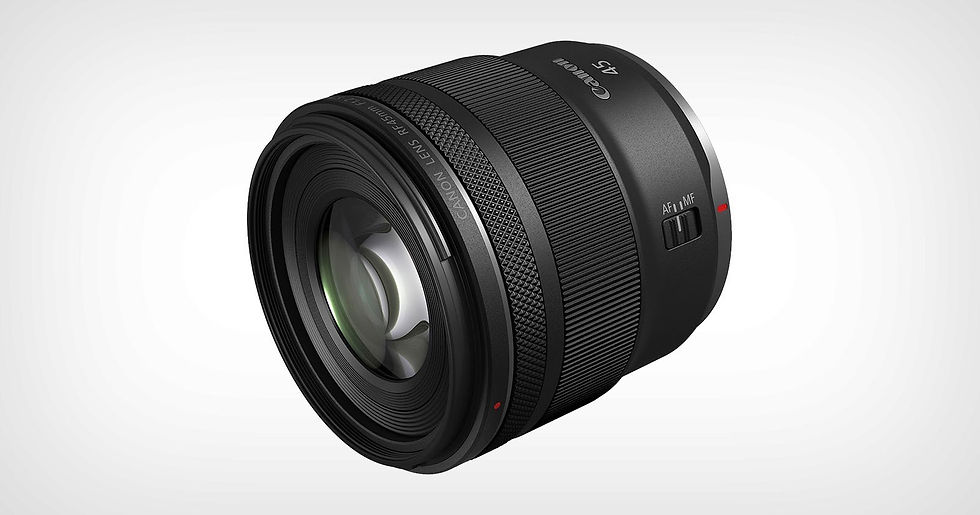
Canon already has several primes around the 50mm mark, but the 45mm focal length gives a slightly wider field of view that may appeal to those who prefer a more natural, documentary-style perspective.
The lens has nine elements in seven groups, including a plastic-molded aspherical element (PMo) designed to keep size and cost down. It weighs 346 grams, measures 75mm in length, and takes 67mm filters, making it reasonably compact for an f/1.2 lens.
Canon says the optical design is tuned more for character than clinical precision, meaning it won’t match the sharpness or aberration control of its L-series lenses. Instead, it is intended to deliver smoother transitions, gentle falloff, and a more organic rendering.
Autofocus is handled by a gear-type STM system with magnetic detection, which is not as quiet or fast as the motors used in Canon’s higher-end glass but helps keep the lens affordable. Like most non-L lenses in Canon’s lineup, the RF 45mm f/1.2 relies on the camera’s in-body lens corrections to manage distortion and vignetting. The use of PMo optics and simpler mechanics makes it noticeably lighter than most f/1.2 lenses, though it’s still about twice the weight of the 50mm f/1.8 STM.
The RF 45mm f/1.2 STM will be released in December for $469.99, and is already available for preorder.


Comments